
Last week I discussed The Wild Robot by Peter Brown and What Makes a Monster? by Jess Keating. Both of these children’s books discussed (albeit in different ways) a fear of the unknown, and how learning about that which you don’t understand allows for acceptance and community building. This week I will be looking at Her Right Foot by Dave Eggers, My Two Blankets by Irena Kobold (illustrations by Freya Blackwood), and Wishtree by Katherine Applegate.
This trio of books builds upon the theme from last week, using the removal of the “monster” label through knowledge as a starting point, rather than the conclusion. These three books also specifically talk about immigration, and the differences between the people that make up communities. Her Right Foot gives the cultural differences a symbol in the form of the Statue Of Liberty, highlighting the fact that one of the things that makes the U.S. so great is its diversity. Millions of people found hope in the statue, and their arrival into our community has made the U.S. what it is.
Wishtree and My Two Blankets go into greater detail about some of the specifics that immigrants experience, and what the community looks like on a micro level rather than a macro one (as discussed by Her Right Foot). In My Two Blankets the main character learns to integrate herself into the strange new culture that she finds herself in with the help of another character who is a native of this culture. Both characters need to work together to make it happen, and the story is of different people reaching across the divide between them. This is a very concrete example of an immigrant’s experiences, challenges, and successes of trying to integrate into a new culture.
Wishtree is similarly about integration into a community, but is told mostly through animals and nature. The book discusses two different communities: A human neighborhood and a collection of animal families that live in the same tree as each other. Both communities are made up of different individuals from different species and different cultures, and both revolve around the tree. At the end of the story, all of the animals show themselves to the humans, even though the laws of nature dictate that they shouldn’t get along: “This just don’t happen … Those animals oughta be eating each other” (201).
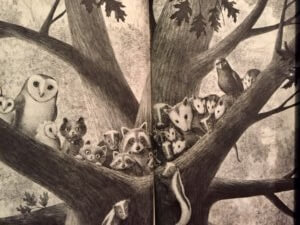
The animals show themselves as a community to prevent the tree from being cut down. Likewise, the humans show themselves to the rest of the human community, trying to prove how much the tree means to them, as well as showing the unity of the community despite their differences. Earlier in the story, someone carved the word “LEAVE” on the tree, since it was on the property of an immigrant family. Just as the tree was in danger of being chopped down, the immigrants were considering moving somewhere else where they could be accepted. The animals came together in their differences to save their home, and the humans came together in their old differences to welcome the new differences.
I say ‘old differences’ because over the years, the neighborhood has been inhabited by all kinds of immigrants, such as Irish and Italian. While these groups historically were discriminated against, they are now accepted.
This brings me back to Her Right Foot which is a book about the Statue of Liberty. The book starts out as a factual book about the statue, and then starts focusing on the design of the statue. The book is full of factual details woven into the narrative such as the building process, design, and the transformation of copper. It also points out the little known fact that the statue’s pose is one of movement: “She is going somewhere! She is on the move!”
As well as these three books, I also read an article by Amy Edwards about teaching critical literacy in the classroom. In this article, Amy talks about what she did to teach critical literacy to her class, and what it really is. One of her big aspirations was to get the class to start thinking about the world through other viewpoints. Doing this requires looking at sociopolitical issues and events through a lens that is not familiar to the reader.
Imagine if My Two Blankets had a book twin, of sorts, that told the story of the helpful and welcoming girl. Most of the class would be able to easily identify with her because she is like them. But the story would not be as impactful. It would instead be a story about being nice to strangers, and how doing so makes you feel good. By reading about Cartwheel and experiencing her transformation, the reader can feel what it is like to arrive in a land where everything is strange, and finally experiencing acceptance.
Now let’s get back to the Statue of Liberty. The book asks why it’s so important that the statue is moving, and presents an answer:
- “If the Statue of Liberty is a symbol of freedom, if the Statue of Liberty has welcomed millions of immigrants to the United States, then how can she stand still? (page break) Liberty and freedom from oppression are not things you get or grant by standing around like some kind of statue. No! These are things that require action. Courage. An unwillingness to rest” (Italics added for emphasis)
The second page of this quote is a great example of matching illustrations to words, and an example to practice critical literacy because of it. Here is the illustration:
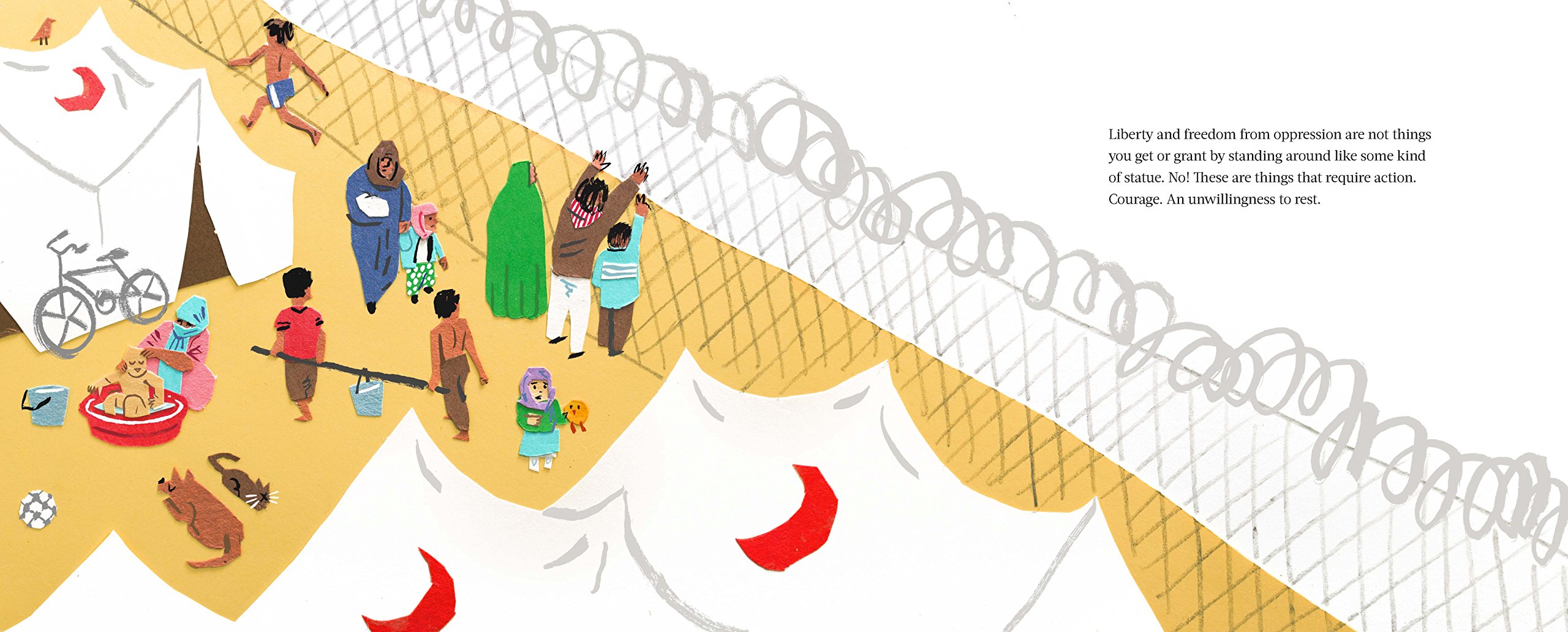
What can we learn from this illustration? Well, we can assume that the depicted scene is far away from the statue. We can assume that the people in the scene are not stereotypical Americans, or part of mainstream American culture. This tells the reader that this scene is far away from the U.S. and far away from them. It tells the reader that the viewpoints of these people is going to be much different from their own. And it tells the reader that in order for these people to see the effects of the Statue of Liberty, we are going to have to go to them.
If I used this book to do something similar to what Amy Edwards did with her class, I would discuss this book with the class, and talk about what I mentioned above. The next part of the discussion would be asking the students to think about how WE view the Statue of Liberty and how someone in this illustration might view it. Next I would ask what it might mean that we don’t think of the statue as moving. Are there limits put on her impact because she can’t move? What does it mean that we as a country view the statue as motionless, lifeless?
These are important questions for everyone to ask, especially in our current day. There are many people who would rather put the chains back on her feet and use the statue as a source of entitlement and symbol of superiority. Is that who we are? Looking at things with a critical lens is vitally important, and asking critical questions is equally so. Because of this, I not only challenge you to think about the questions I posed about the Statue of Liberty, but also this: How are you promoting acceptance within your community?
Citations:
 Lazy Reads and Thoughts