
My last blog post was about H. M. Bouwman’s A Crack in the Sea which I thoroughly enjoyed. One of the plot lines in the book is about a group of Vietnamese people trying to leave the country by boat in order to seek refuge any where else. The books that I read this week expand upon the refugee experience throughout history. These books were Stormy Seas: Stories of Young Boat Refugees by Mary Beth Leatherdale and Eleanor Shakespeare, and Traveling the Blue Road: Poems of the Sea collected by Lee Bennett Hopkins and illustrated by Bob Hansman & Jovan Hansman.
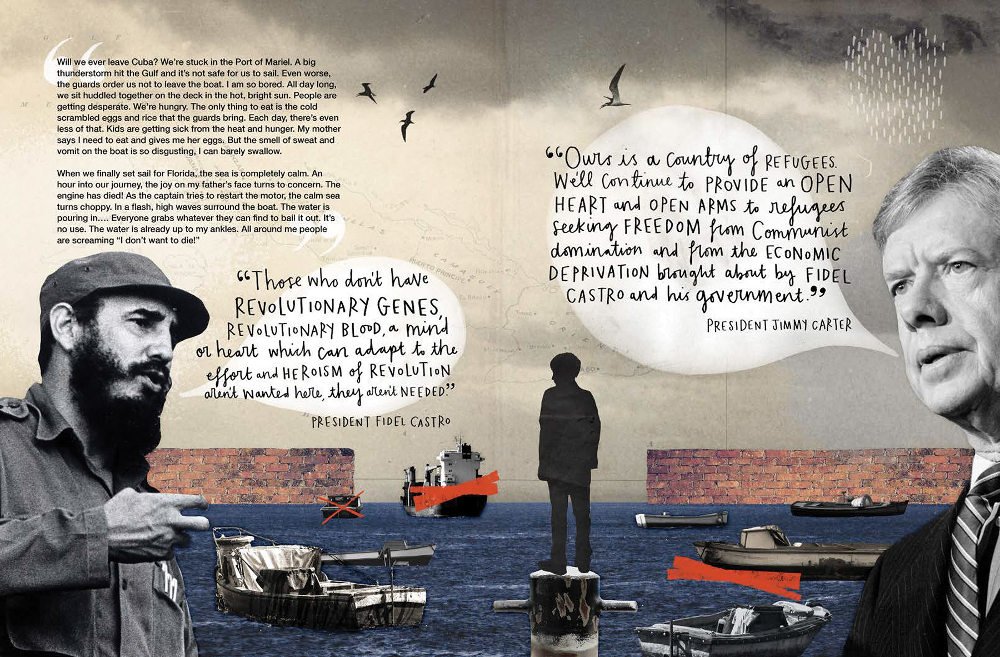
Both of these books are targeted for children, and I enjoyed both of them, and thought them to be very important. Stormy Seas tells the stories of several children from different parts of our world and history. These stories show the hardships and horrors of both what they are fleeing, and what they endure in order to find a better life. Each story is true, and ends by telling the reader what they have accomplished with their life because of the journey that they made, and because of the people that let them into their country. Many of these people went on to do incredible and amazing things.

The fact that this book points this out is important. Too often in the media we are told to fear the refugees, or are told to worry about them taking our jobs, or committing crimes against us even though statistics clearly show that this is not the case. The sooner that we can get people resistant to such fear-mongering, the better. And this book allows us to reach children, and start this process young.
This book is also very important because in many of the stories, the hardships don’t end once they cross the ocean. Several of the children are mistreated, imprisoned, and persecuted by the people of the country that let them in. A lot of this mistreatment stems from the fear-mongering, which is further reason to break the cycle. These people have been through more than anyone should have to.
Aside from the moral awareness lessons of the book, it is also a great way to introduce topics in history or geography. With each new story, the reader can learn about a new topic, point in history, culture, or issue in our world, and I’m sure that many children reading the stories will want to learn more. Conveniently, most of the pages in the books have small sections that give background information, quotes, and definitions of some of the words. This helps bring each story to life, and sets it firmly in our world. It doesn’t seem as detached, and helps each story become more powerful.
Traveling the Blue Road is also very useful for this. This book is a collection of poems about traveling the sea, many of which deal with refugees, and some are about the slave trade. The first poem in the book is about Christopher Columbus’ voyage across the Atlantic, and the last is about the Sea-going Sama people of our present day. That is several hundred years worth of interesting, intriguing, and important history that future citizens of the world need to know.

Both of these books serve as an entry point into learning about this history by providing interesting and relevant stories to the reader, backed by incredible illustrations and visuals that bring each page to life. I know that’s cliche but it’s true. Both these books urge the readers to view refugees with humanity and compassion, as well as make the reader look back through our history not as a series of isolated facts, but as a rich history of stories and struggles by real people.
To help myself and my colleagues fully realize this fact, my professor assigned us to write two persona poems. One of the poems was to be about a character from A Crack in the Sea and the other was to be about a child from Stormy Seas. The first one I wrote I called Storyteller and it is about Thanh.
Storyteller
Filled with visions and thoughts from far away
My eyes zone out and I travel to a distant place.
The gleaming hero in the corner beckons me,
Children’s laughter echoes, soldiers threaten me.
I am not a child of academia, I am a storyteller.
Filled with feelings of inferiority
And the pangs of hunger gnawing at me,
At the searing sun and endless waves,
I lose all hope, in desperation I shout and rave.
I am not a hero, I am a storyteller.
Filled with water, searching for a way out
Sinking to die, revived with a shout.
Living with wonder and hope once more
I am welcomed upon floating shore.
I am not alone, I am a storyteller,
I am home, I am a storyteller.
Writing this poem was fun. I have written a lot of poetry before, but have not in a while, and I enjoyed going back to it. The first two lines of the first stanza came very quickly to me, and so I knew that I had a rhyme scheme if I wanted one. I decided that I would do two sets of rhymes for each stanza, and I would end each stanza with the same line, that also came very quickly to me. Throughout the poem, this final line begins with “I am not…”, and at the end of poem I had two different options to end on “I am not alone” or “I am home”. I ended up deciding to keep the pattern going, and adding a final line that broke the pattern, further reinforcing the message.
The second poem I wrote was about Najeeba’s story of fleeing Afghanistan.
This Piece of Wood
Running from the people who wouldn’t let me learn of the place I am going
Hiding with my family in the darkness of their shadow
Hunted for being different, hated for wanting to leave.
Floating on this battered piece of wood, legs cramping, knees in my chest
The sky opens up and attacks us viciously, waves spilling over, terror of the deep
Hunted for being different, hated for wanting to leave.
Helped at a cost, they don’t care about our humanity
I need this, I join the pact to get to Australia or die
Hunted for being different, hated for wanting to leave.
Forced to welcome us, they let us in, and give us all a number
Crammed into a prison, they mock us, they mistreat us
Hunted for being different, hated for wanting to leave.
I leave that place behind and start a new life, start a new me
Surrounded by foreign people and their customs, I work hard
Hunted for being different, hated for wanting to leave.
Now I help those like me, the hunted and hated
I try to make the world a better place, so that no one else suffers like I did
Love those who are different, welcome those forced to leave.
Unlike Storyteller, I decided not to have a rhyme scheme, and I did not break the pattern with a single line at the end of poem. Instead I broke the pattern in the last stanza. At first I had a harder time starting this poem. I knew that I wanted to use a different format than Storyteller but I did not know Najeeba as well as I knew Thanh. However, once I started, it just kept coming. Instead of a rhyme scheme, I decided to match the number of commas in both lines of each stanza. If the first line had one comma, the second would as well. Same for three or two commas. As with Storyteller the repeating line of each stanza came to me quickly, and I decided to repeat it since the meaning can be true for both the Taliban and the Australians. And that’s a powerful message if I do say so myself.
Sources:
Leatherdale, M. B., & Shakespeare, E. (2017). Stormy Seas. Toronto: Annick Press.
Traveling the blue road: Poems of the sea. (2017). Lake Forest, CA: Seagrass Press.
 Lazy Reads and Thoughts